
Training should be focused on improving performance by making sure everyone knows the correct way of doing their jobs.
Training is not for free, it includes the elaboration, materials and the delivery cost and the cost of the employees being away from their job for the training process. These costs can be an investment or a waste of money depending on the final result, if the process was good and the employee reached the goal expected, then it is an investment but if the goal wasn´t reached then it is a waste of money and time.
Training the workforce
Key Training Issues
-Keeping pace with a changing organizational environment – online and web info
-Take place in a classroom setting or on the job – classroom locked real situations and on the job training is more effective and real but can slow the customer attention.
-How can training be delivered effectively worldwide – provide online content
-How the trainees can be motivated to learn – related content to their jobs, personalized
Training vs Development
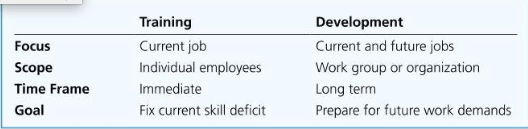
Training goal: improving performance
Development goal: Enriched and more capable workers
Challenges in training
The manager must seek to answer the following questions in order to have a clear vision of the training process.
Is training the solution? – eliminate or improve performance problems.
Are the goals clear and realistic? – clearly stated goals to guide the content of the program and determine the criteria by which its effectiveness will be judged.
Is training a good investment? – It is not really the cost that should be the important issues much as the effectiveness of the investment.
Will training work? – will not work unless it is related to organizational goals.
Managing the training process
To maximize the benefits of training managers must monitor the process very closely.
The needs assessment phase.
Determine whether training is needed and if so, determine the needed information for the program.
This process consists of 3 levels of analysis: organizational (identify organizational needs and the level of support for training), task (understand job requirements) and person (which employees need training).
Clarify the objectives of training.
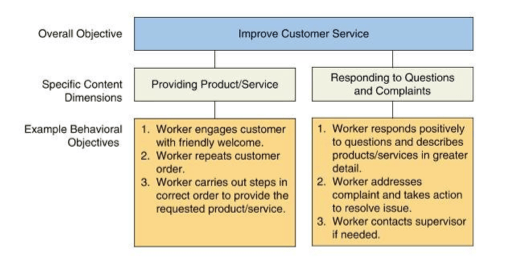
Training and conduct phase
Location options – off the job, trip, etc.
Presentation Options – video, slides, virtual reality, etc.
Types of training – Coss functional, creativity, etc.
Evaluation Phase
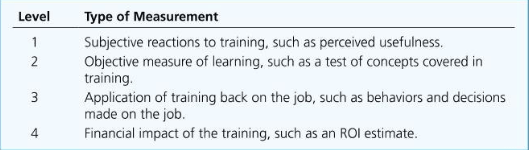
Here the effectiveness of the training program is assessed.
It is used commonly a framework to evaluate the effectiveness of training that consists of 4 levels.
Legal issues and training.
Equal opportunity for everyone, no discrimination, etc.
Orientations and Socialization.
Orientation is when a new employee entrance to the firm and it is the manager´s job to oriented him about the company and the roles that he will be doing.
Socialization is a long-term process in which the new employee will start to acclimate himself into the company environment.
Developing careers
Career development is an ongoing, organized and formalized effort that recognize people as a vital organizational resource. It has a wider focus than training.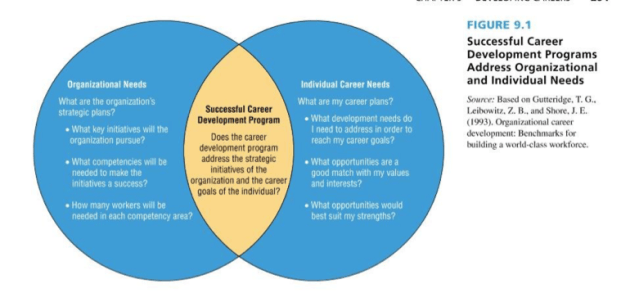
Challenges in career development
The manager need to determine:
- who will be responsible for the development
- how much emphasis on the development is appropriate
- how the development need of a diverse workforce will be met
Meeting the challenges of effective development
Career development is a cycle of 3 phases:
- assessment phase – employees skills, values, and interests are identified.
- direction phase – type of career that employees want.
- development phase – take actions to create and increase employees skills.
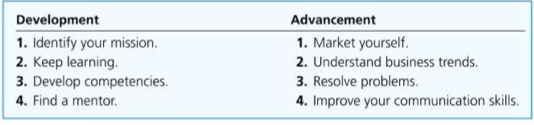
Self Development
The employees must take a role in their own development process.
To define career success the following 3 domain is used:
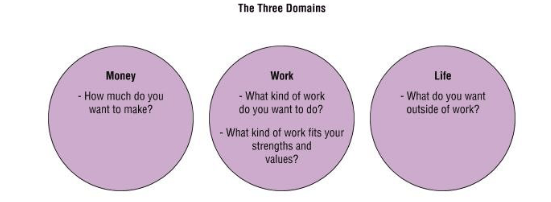
These domains need to be examined constantly like every 3 or 5 years.
Suggestions for self-development.
Sources:
Gomez-Mejia, L.R., Balkin, D.B. and Cardy, R.L. 2016. Managing Human Resources. Global Edition 8/E. Pearson. London. ISBN-10: 1292097248 • ISBN-13: 9781292097244 . (chapter 8 and 9. (p 263-313)).
 Basics of Human Resource Management