Total Rewards and Employee Engagement

MANAGING COMPENSATION

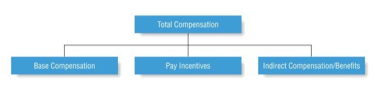
Total compensation is the physic rewards an employee receives for his labors and this includes 3 other components.

Screen Shot 2019-03-31 at 8.44.09 PM.png

  • Base compensation: the regular payment that an employee receives. (paycheck).
  • Pay Incentive: A program designed to reward employees for good performance. (bonuses)
  • Indirect Compensation/Benefits: the programs that employees acquire when being part of a company and that they pay in a certain way. ( health insurance, vacations, unemployment compensations).

Compensation is the most important cost in most firms.

DESIGNING A COMPENSATION SYSTEM

Compensation affects a person economically, sociologically, and physiologically this is why taking low care of compensation can create issues and impact negatively on employees, therefore on the company´s performance.

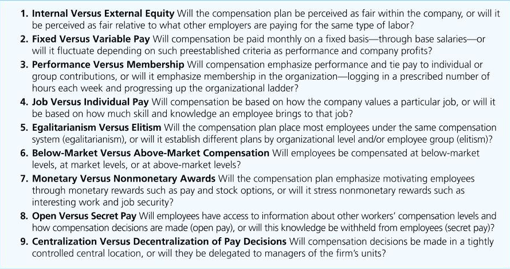
The nine criteria for developing a compensation plan:

Screen Shot 2019-03-31 at 8.57.51 PM.png

INTERNAL AND EXTERNAL EQUITY

Internal: the perception of fairness related to the pay structure of a firm.

External: the perceived fairness of the payment related to other´s employers’ way of payment to employees for the same job.

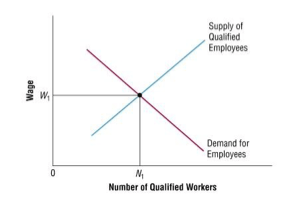
Here managers can use two basic models:

  1. The distributive justice model: employees exchange their contributions or input to the firm for a set of outcomes.
  2. The labor market model: the wage rate for any given occupation is set at the point where the supply of labor equals the demand for labor in the market place.

Screen Shot 2019-04-01 at 11.30.43 AM.png


SOURCES:

  • Gomez-Mejia, L.R., Balkin, D.B. and Cardy, R.L. 2016. Managing Human Resources. Global Edition 8/E. Pearson. London. ISBN-10: 1292097248 • ISBN-13: 9781292097244. Available in Pasila library as a physical and e-book. (select: Read Online)


MANAGING WORKPLACE SAFETY AND HEALTH

Safety and health regulations help assure that the choice to provide labor does not involve unnecessary risks.

Workplace Safety and the Law 

Workers´ Compensation

The concept is based on the theory that work-related accidents and illness are costs of doing business that the employer should pay for and pass on to the consumer.

Nowadays, all USA have had workers compensation programs that are designed to provide financial and medical assistance to employees injured on the job.

The goals are:

  • To provide effective medical care to victims and their dependents.
  • Providing a no-fault system
  • Encourage to invest in safety
  • Research on workplace safety

This applies when the accident occurs in the workplace.

The benefits of the compensation:

  • Total disability benefits
  • Impairment benefits
  • Survivor benefits
  • Medical expenses benefits
  • Rehabilitation benefits

The cost of workers compensation

It is based on payroll, but they are modified by an organization´s safety record. The average is from around 2% to more than 4% per 100 dollars of wages, but the rate can increase in some industries like construction.

The occupational safety and health act (OSHA)

It imposes 3 major obligations on employers:

  • To provide a safe and healthy work environment.
  • To comply with specific occupational safety and health standards.
  • To keep records of occupational injuries and illness

As a Human Resources manager is important to keep the workplace safe, educate employees about the workers’ compensation system, communicate with the claimant and with others familiar with the incident and stay in contact with employees on workers compensation leave.

Managing contemporary safety, health and behavioral issues

The most significant safety, health, and behavioral issues for employees are AIDS., violence in the workplace, cumulative trauma disorders, fetal protection, hazardous chemicals, and genetic testing. In all these areas, line managers must deal with a variety of practical, legal, and ethical questions that often demand a careful balancing of individual rights with the needs of the organization.

Safety and health programs

Comprehensive safety programs are well-planned efforts in which management involves employees. EAOs are designed to help employees cope with physical, mental or emotional probñems that are undermining their job performance.

MY OWN RESEARCH ABOUT THE TOPIC.

The IMSS, is the institution with the greatest presence in health care and in the social protection of Mexicans since its foundation in 1943, for this, it combines research and medical practice, with the administration of resources for the retirement of its insured, to provide peace and stability to workers and their families, before any of the risks specified in the Social Security Law. Today, more than half of the Mexican population has something to do with the Institute, until now, the largest of its kind in Latin America.

.Screen Shot 2019-03-26 at 5.53.54 PM.png

  • IMSS Research has shown that every hour, 47 labor accidents happen and 1 constructor dies every 8 hours.
  • illnesses related to job increased by 12.2%.
  • The sectors with a higher percentage of illnesses and accidents are construction and services of accommodation and agriculture.
  • In Mexico, workers need to be affiliated by the company to IMSS.

The following screen capture has different examples of labor accidents happened in January2018.

Screen Shot 2019-03-26 at 5.59.48 PM.png

SOURCES:


APPRAISING & MANAGING PERFORMANCE

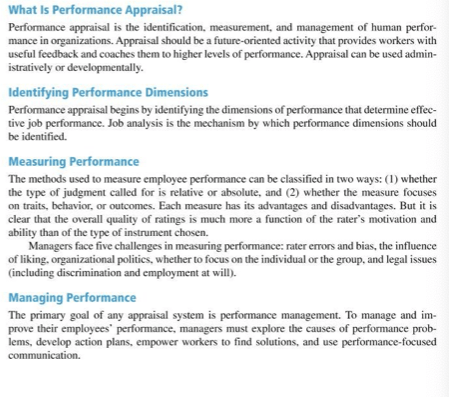
Performance Appraisal is the process that identifies, measure, and manage human performance in organizations.

  • Identification: determine which areas should be examined based on job analysis.
  • Measurement: make managerial judgments about how good or bad is employee performance and all managers in the company must have comparable rating standards.
  • Management: take a view of the future about what employees can do to raise their potential in the company so managers must give employees feedback and coach them to reach higher levels of performance.

Uses of Performance Appraisal

It is used mostly for administrative and/or developmental purposes.

  • Administrative: basis for a decision about employee´s work conditions, promotions, termination, and rewards.
  • Developmental: improving employees performance and strengthening their job skills, feedback, counseling, and training.

P.A can be the key to improve and develop employees if it is used effectively.

Identifying Performance Dimensions

The very 1st step is to identify what you have to measure.

  • Quality of work done
  • Quantity of work performed
  • Effectiveness
  • and other areas or dimensions through a job analysis

Job Analysis: the mechanism by which performance dimensions should be identified.

Screen Shot 2019-03-02 at 3.19.52 PM.png

Benefits of P.A

Add value to the business helping to identify the performance dimensions focused on competencies.

Measuring Performance

It is difficult to quantify some competencies such as creativity but in the case of the quantifiable ones then it can be labeled as good, excellent, poor, etc.

Measurement Tools

Appraisal formats can be classified in two ways: by the type of judgment that is required and by the focus of the measure.

Relative and Absolute Judgments

  • Based on relative judgments ask the supervisor to compare between employee´s performance at the same job and provide a rank order of employees from the best to the worst. Also, the workers can be classified into groups as top, middle, etc.

In this way is the supervisor’s job to know the workers in order to classify them but it can start conflict among workers.

  • Based on absolute judgments ask the supervisor to make judgments about the employee´s performance and rate them without comparison.

Trait, Behavioral, and outcome data

  • Trait asks the supervisor to make judgments about traits through trait-based rating scales such as decisiveness, reliability, energy, and loyalty.
  • Behavioral focus on assessing a worker´s behaviors such as: works well with coworkers, comes to meeting on time. The best known behavioral i¡scale is BARS ( Behaviorally Anchored Rating Scale).

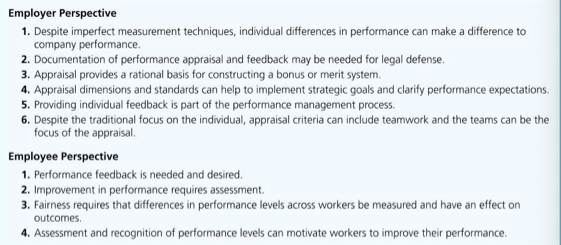
Summary

Screen Shot 2019-03-03 at 10.51.17 PM.png

SOURCES:

Gomez-Mejia, L.R., Balkin, D.B. and Cardy, R.L. 2016. Managing Human Resources. Global Edition 8/E. Pearson. London. ISBN-10: 1292097248 • ISBN-13: 9781292097244. CHAPTER 7.

Learning and Development

Training should be focused on improving performance by making sure everyone knows the correct way of doing their jobs.

Training is not for free, it includes the elaboration, materials and the delivery cost and the cost of the employees being away from their job for the training process. These costs can be an investment or a waste of money depending on the final result, if the process was good and the employee reached the goal expected, then it is an investment but if the goal wasn´t reached then it is a waste of money and time.

Training the workforce

Key Training Issues

-Keeping pace with a changing organizational environment – online and web info

-Take place in a classroom setting or on the job – classroom locked real situations and on the job training is more effective and real but can slow the customer attention.

-How can training be delivered effectively worldwide – provide online content

-How the trainees can be motivated to learn – related content to their jobs, personalized

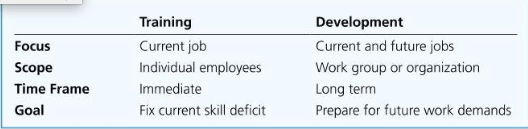
Training vs Development
Screen Shot 2019-02-25 at 8.36.55 AM.png

Training goal: improving performance

Development goal: Enriched and more capable workers

Challenges in training

The manager must seek to answer the following questions in order to have a clear vision of the training process.

Is training the solution? – eliminate or improve performance problems.

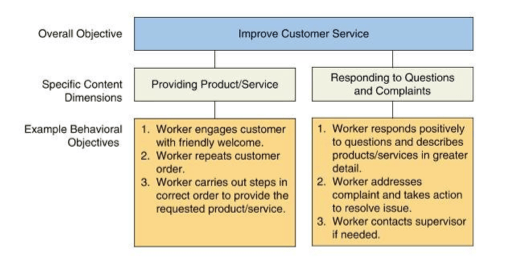
Are the goals clear and realistic? – clearly stated goals to guide the content of the program and determine the criteria by which its effectiveness will be judged.

Is training a good investment? – It is not really the cost that should be the important issues much as the effectiveness of the investment.

Will training work? – will not work unless it is related to organizational goals.

Managing the training process

To maximize the benefits of training managers must monitor the process very closely.

The needs assessment phase. 

Determine whether training is needed and if so, determine the needed information for the program.

This process consists of 3 levels of analysis: organizational (identify organizational needs  and the level of support for training), task (understand job requirements) and person (which employees need training).

Clarify the objectives of training.
Screen Shot 2019-02-25 at 8.52.52 AM.png

Training and conduct phase

Location options – off the job, trip, etc.

Presentation Options – video, slides, virtual reality, etc.

Types of training – Coss functional, creativity, etc.

Evaluation Phase

Here the effectiveness of the training program is assessed.

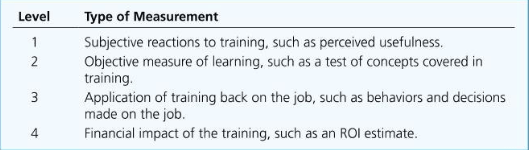
It is used commonly a framework to evaluate the effectiveness of training that consists of 4 levels.
Screen Shot 2019-02-25 at 8.59.54 AM.png

Legal issues and training.

Equal opportunity for everyone, no discrimination, etc.

Orientations and Socialization.

Orientation is when a new employee entrance to the firm and it is the manager´s job to oriented him about the company and the roles that he will be doing.

Socialization is a long-term process in which the new employee will start to acclimate himself into the company environment.

Developing careers

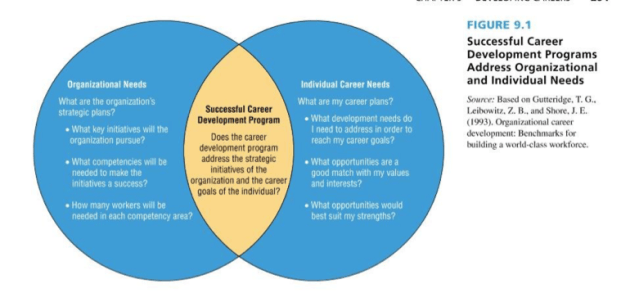
Career development is an ongoing, organized and formalized effort that recognize people as a vital organizational resource. It has a wider focus than training.Screen Shot 2019-02-25 at 9.11.46 AM 1.png
Challenges in career development

The manager need to determine:

  • who will be responsible for the development
  • how much emphasis on the development is appropriate
  • how the development need of a diverse workforce will be met

Meeting the challenges of effective development

Career development is a cycle of 3 phases:

  • assessment phase – employees skills, values, and interests are identified.
  • direction phase – type of career that employees want.
  • development phase – take actions to create and increase employees skills.

Self Development

The employees must take a role in their own development process.

To define career success the following 3 domain is used:
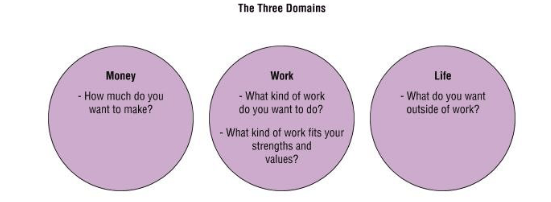
Screen Shot 2019-02-25 at 9.20.13 AM.png

These domains need to be examined constantly like every 3 or 5 years.

Suggestions for self-development.
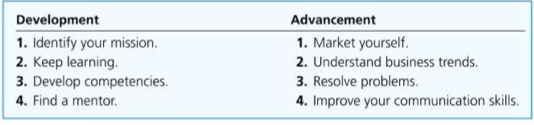
Screen Shot 2019-02-25 at 9.22.07 AM.png

Sources:

Gomez-Mejia, L.R., Balkin, D.B. and Cardy, R.L. 2016. Managing Human Resources. Global Edition 8/E. Pearson. London. ISBN-10: 1292097248 • ISBN-13: 9781292097244 . (chapter 8 and 9. (p 263-313)).

Recruitment & Selection

chapter 5 (p. 177-208) and chapter 3 pages 134-136

The recruitment and selection process of a company involves many aspects to consider when it comes to the company needs.

That is why Human Resource planning is so important because in here you can measure if you have the right people and the right amount so everything flows accordingly in your company, so when a job opportunity is available you can know if you will promote someone that is your employee already or if you are gonna hire someone from the outside.

The recruitment process has its own point to take care of as:

– Determining characteristics Important to performance

-Measuring Characteristics that determine performance

– Motivation rather than ability

The Selection is after you have all the applicants profiles so you need to make decisions, in here the most common methods used are:

– Letters of recommendation

-Application forms

-Ability test

-Personality test

-Honesty test

-Interviews

But it is not only about recruiting and selecting, but also you need to pay attention to the legal issues in staffing as:

– Discriminatory laws (Disabilities, age, color, sex, religion, race and national origin).

-Affirmative Actions

-Negligent hiring

Matching all this information with the Abercrombie article it is all about a careless and dysfunctional process in recruitment and hiring, starting from the way that the author of the article was first invited, she was not even looking for a job, the recruitment girl just see her and was based in her appearance 100%, as the author mentioned no one was asked for a recommendation letter or a way to determine their skills and competencies.

When reading the article I ask myself, Do a well-looking person has more abilities than a not that gorgeous one? I mean, I do not even know what gorgeous means at all, because everyone has a different perspective.

It is true that nowadays the brands had to move to this new generation of “we all are perfect” so they had to accept new ways of marketing and selling such as that our differences make us perfect and that we all are the same.

So in conclusion, for a company is pretty important to take care of this department seriously, because a pretty face is useless if it has no motivation, abilities, skills and all the bunch of requisites that are needed to cover a job.

SOURCES:

  • Gomez-Mejia, L.R., Balkin, D.B. and Cardy, R.L. 2016. Managing Human Resources. Global Edition 8/E. Pearson. London. ISBN-10: 1292097248 • ISBN-13: 9781292097244