
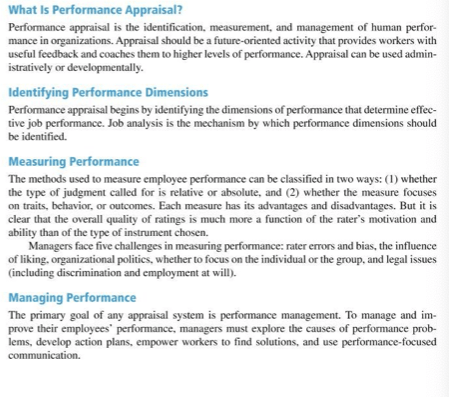
Performance Appraisal is the process that identifies, measure, and manage human performance in organizations.
- Identification: determine which areas should be examined based on job analysis.
- Measurement: make managerial judgments about how good or bad is employee performance and all managers in the company must have comparable rating standards.
- Management: take a view of the future about what employees can do to raise their potential in the company so managers must give employees feedback and coach them to reach higher levels of performance.
Uses of Performance Appraisal
It is used mostly for administrative and/or developmental purposes.
- Administrative: basis for a decision about employee´s work conditions, promotions, termination, and rewards.
- Developmental: improving employees performance and strengthening their job skills, feedback, counseling, and training.
P.A can be the key to improve and develop employees if it is used effectively.
Identifying Performance Dimensions
The very 1st step is to identify what you have to measure.
- Quality of work done
- Quantity of work performed
- Effectiveness
- and other areas or dimensions through a job analysis
Job Analysis: the mechanism by which performance dimensions should be identified.
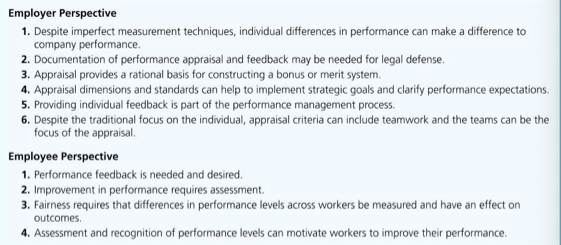
Benefits of P.A
Add value to the business helping to identify the performance dimensions focused on competencies.
Measuring Performance
It is difficult to quantify some competencies such as creativity but in the case of the quantifiable ones then it can be labeled as good, excellent, poor, etc.
Measurement Tools
Appraisal formats can be classified in two ways: by the type of judgment that is required and by the focus of the measure.
Relative and Absolute Judgments
- Based on relative judgments ask the supervisor to compare between employee´s performance at the same job and provide a rank order of employees from the best to the worst. Also, the workers can be classified into groups as top, middle, etc.
In this way is the supervisor’s job to know the workers in order to classify them but it can start conflict among workers.
- Based on absolute judgments ask the supervisor to make judgments about the employee´s performance and rate them without comparison.
Trait, Behavioral, and outcome data
- Trait asks the supervisor to make judgments about traits through trait-based rating scales such as decisiveness, reliability, energy, and loyalty.
- Behavioral focus on assessing a worker´s behaviors such as: works well with coworkers, comes to meeting on time. The best known behavioral i¡scale is BARS ( Behaviorally Anchored Rating Scale).
Summary
SOURCES:
Gomez-Mejia, L.R., Balkin, D.B. and Cardy, R.L. 2016. Managing Human Resources. Global Edition 8/E. Pearson. London. ISBN-10: 1292097248 • ISBN-13: 9781292097244. CHAPTER 7.

